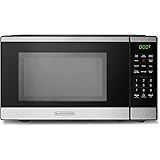
A microwave oven heats food very quickly by absorbing ELECTROMAGNETIC WAVES. The waves can be reflected off metal and glass, pass through plastics and paper, and are absorbed by food molecules. The energy from the waves is absorbed uniformly throughout the item to cook it evenly. This is unlike conventional ovens which rely on conduction to slowly transfer heat from the outside to the inside.
Microwaves are electromagnetic waves with wavelengths between about one meter and a millimeter, or 300 MHz and 300 GHz. The prefix “micro” is used because the waves have shorter wavelengths than radio waves or infrared radiation, and are much smaller than the waves used in radar (300 GHz is about 3 cm).
Jagadish Chandra Bose in 1894 invented spark oscillators to generate millimeter-wave frequencies, but he did not use the term “microwave”. The first experimental microwave transmitters were built at Westinghouse laboratories in 1933 and transmitted voice, telegraph and facsimile data over 3.3 GHz bidirectional beams at the focus of 10-foot (3 m) metal dishes. The technology was rapidly exploited after World War II because of its ability to transmit information very long distances.
The high frequency of microwaves allows signals to be focused into narrower beams than for lower frequencies and also allows much higher data transmission rates. In the 1960s microwave relay networks were constructed across the US and Europe to transmit telephone, television and telegraph data between cities. Today microwaves are used extensively for point-to-point telecommunications, to provide voice, video and data services as well as supervisory control and data acquisition (SCADA) for remote machinery, switches, valves and signals.
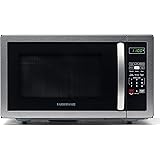
Farberware 1.1 Cu. Ft. Countertop Microwave Oven – 1000 Watts Power, Auto Cook Settings, Defrost, Easy Clean and Child Safety Lock - Stainless
$129.99 (as of January 14, 2026 19:13 GMT +00:00 - More infoProduct prices and availability are accurate as of the date/time indicated and are subject to change. Any price and availability information displayed on [relevant Amazon Site(s), as applicable] at the time of purchase will apply to the purchase of this product.)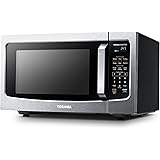
TOSHIBA ML-EM45PIT(SS) Countertop Microwave Oven with Inverter Technology, Kitchen Essentials, Smart Sensor, Auto Defrost, 1.6 Cu.ft, 13.6" Removable Turntable, 33lb.&1250W, Stainless Steel
$179.91 (as of January 14, 2026 19:13 GMT +00:00 - More infoProduct prices and availability are accurate as of the date/time indicated and are subject to change. Any price and availability information displayed on [relevant Amazon Site(s), as applicable] at the time of purchase will apply to the purchase of this product.)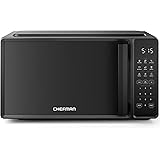
Chefman Countertop Microwave Oven 0.7 Cu. Ft., 700 Watts with 10 Power Levels, 6 Cooking Presets with One-Touch Express Cook, Eco Mode, Child Safety Lock, & Mute Button - Black
$68.96 (as of January 14, 2026 19:13 GMT +00:00 - More infoProduct prices and availability are accurate as of the date/time indicated and are subject to change. Any price and availability information displayed on [relevant Amazon Site(s), as applicable] at the time of purchase will apply to the purchase of this product.)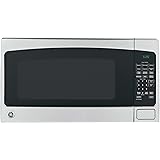
GE Countertop Microwave Oven,1, 200-watt Capacity, 2.0 Cubic Ft., 8 Auto Setting Cooking Settings, Child-Lock Technology, Kitchen Essentials for the Countertop, Dorm Room or Apartment, Stainless Steel
$259.99 (as of January 14, 2026 19:13 GMT +00:00 - More infoProduct prices and availability are accurate as of the date/time indicated and are subject to change. Any price and availability information displayed on [relevant Amazon Site(s), as applicable] at the time of purchase will apply to the purchase of this product.)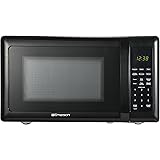
Emerson MW7302B Compact Countertop Microwave Oven with Touch Control, LED Display, 700W, 10 Power Levels, 6 Auto Menus, Glass Turntable and Child Safe Lock, 0.7 Cu., Ft. Black
$69.49 (as of January 14, 2026 19:13 GMT +00:00 - More infoProduct prices and availability are accurate as of the date/time indicated and are subject to change. Any price and availability information displayed on [relevant Amazon Site(s), as applicable] at the time of purchase will apply to the purchase of this product.)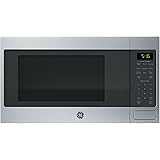
GE Countertop Microwave Oven, 1,150-watt Capacity, 1.6 Cubic Ft., 8 Auto Setting Cooking Settings, Child-Lock Technology, Kitchen Essentials for the Countertop, Dorm Room or Apartment, Stainless Steel
$199.99 (as of January 14, 2026 19:13 GMT +00:00 - More infoProduct prices and availability are accurate as of the date/time indicated and are subject to change. Any price and availability information displayed on [relevant Amazon Site(s), as applicable] at the time of purchase will apply to the purchase of this product.)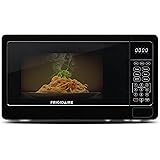
FRIGIDAIRE EMW733BLACKAMZ 0.7 Cu. Ft. Microwave, Black
$69.00 (as of January 14, 2026 19:13 GMT +00:00 - More infoProduct prices and availability are accurate as of the date/time indicated and are subject to change. Any price and availability information displayed on [relevant Amazon Site(s), as applicable] at the time of purchase will apply to the purchase of this product.)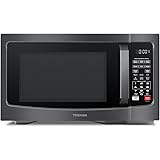
TOSHIBA EM131A5C-BS Countertop Microwave Ovens 1.2 Cu Ft, 12.4" Removable Turntable Smart Humidity Sensor 12 Auto Menus Mute Function ECO Mode Easy Clean Interior Black Color 1000W
$133.98 (as of January 14, 2026 19:13 GMT +00:00 - More infoProduct prices and availability are accurate as of the date/time indicated and are subject to change. Any price and availability information displayed on [relevant Amazon Site(s), as applicable] at the time of purchase will apply to the purchase of this product.)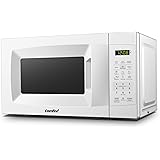
COMFEE' EM720CPL-PM Countertop Microwave Oven with Sound On/Off, ECO Mode and Easy One-Touch Buttons, 0.7 Cu Ft/700W, Pearl White
$69.99 (as of January 14, 2026 19:13 GMT +00:00 - More infoProduct prices and availability are accurate as of the date/time indicated and are subject to change. Any price and availability information displayed on [relevant Amazon Site(s), as applicable] at the time of purchase will apply to the purchase of this product.)