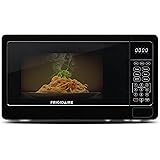
Microwaves are used to heat food in microwave ovens, facilitate communication in mobile phone and satellite systems, and enable radar systems to detect objects and measure their distance and speed. In the case of the first, they cause water molecules in food to vibrate and generate heat; this can reduce cooking time by a factor of a hundredfold. Glass and metal foils are unaffected by microwaves, however.
This technology is also widely used in industrial processes, such as the heating of plastic rods prior to extrusion. In these applications, it is important to keep in mind that microwaves cannot easily heat liquids uniformly; as a result, they may boil or erupt suddenly. To avoid this, it is advisable to stir liquids before and during heating, and to use a covered microwave-safe container.
In addition, the fact that microwaves are volumetric rather than surface-based, enables them to penetrate into a wide variety of solid and semi-solid materials. This can be useful in reducing production run times and in eliminating the problems of convective drying such as local overheating, product case hardening, and surface-cracking.
The microwave frequencies that are commonly used for cooking and communications operate in the millimeter wave range of the electromagnetic spectrum (3 – 1000 GHz). As such, they can be detected with dishes arranged in a radio telescope. Large dish antennas are also used to bounce microwave signals off planets in the solar system and astronomical radio sources such as galaxies and nebulae, allowing scientists to measure their distances.
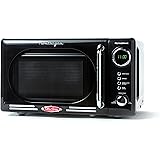
Nostalgia Retro Compact Countertop Microwave Oven, 0.7 Cu. Ft. 700-Watts with LED Digital Display, Child Lock, Easy Clean Interior, Black
$89.99 (as of January 14, 2026 19:13 GMT +00:00 - More infoProduct prices and availability are accurate as of the date/time indicated and are subject to change. Any price and availability information displayed on [relevant Amazon Site(s), as applicable] at the time of purchase will apply to the purchase of this product.)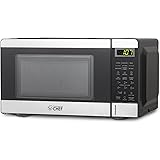
COMMERCIAL CHEF 0.7 Cubic Foot Microwave with 10 Power Levels, Small Microwave with Push Button, 700W Countertop up to 99 Minute Timer and Digital Display, Stainless Steel
$70.76 (as of January 14, 2026 19:13 GMT +00:00 - More infoProduct prices and availability are accurate as of the date/time indicated and are subject to change. Any price and availability information displayed on [relevant Amazon Site(s), as applicable] at the time of purchase will apply to the purchase of this product.)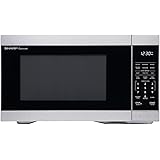
SHARP Countertop Microwave Oven with Removable 12.4" Carousel Turntable, 1000 Watt, 1.1 Cubic Feet, Stainless Steel
$179.97 (as of January 14, 2026 19:13 GMT +00:00 - More infoProduct prices and availability are accurate as of the date/time indicated and are subject to change. Any price and availability information displayed on [relevant Amazon Site(s), as applicable] at the time of purchase will apply to the purchase of this product.)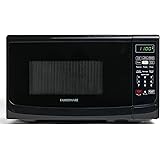
Farberware 0.7 Cu. Ft. Countertop Microwave Oven – 700 Watts Power, Auto Cook Settings, Defrost, Easy Clean and Child Safety Lock - Black
$69.99 (as of January 14, 2026 19:13 GMT +00:00 - More infoProduct prices and availability are accurate as of the date/time indicated and are subject to change. Any price and availability information displayed on [relevant Amazon Site(s), as applicable] at the time of purchase will apply to the purchase of this product.)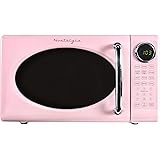
Nostalgia Retro Microwave Oven - 0.7 Cu Ft, 700-Watt Countertop Size with Glass Turntable, Child Safety Lock, 8 Auto-Cook Programs, Digital Clock - Pink
$89.99 (as of January 14, 2026 19:13 GMT +00:00 - More infoProduct prices and availability are accurate as of the date/time indicated and are subject to change. Any price and availability information displayed on [relevant Amazon Site(s), as applicable] at the time of purchase will apply to the purchase of this product.)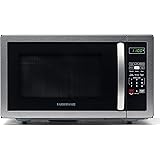
Farberware 1.1 Cu. Ft. Countertop Microwave Oven – 1000 Watts Power, Auto Cook Settings, Defrost, Easy Clean and Child Safety Lock - Stainless
$129.99 (as of January 14, 2026 19:13 GMT +00:00 - More infoProduct prices and availability are accurate as of the date/time indicated and are subject to change. Any price and availability information displayed on [relevant Amazon Site(s), as applicable] at the time of purchase will apply to the purchase of this product.)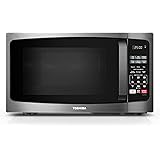
TOSHIBA ML-EM09PA(BS) Small Microwave Oven with 6 Auto Menus, Mute Function & Child Lock, LED Lighting, Perfect for Apartment, 0.9 Cu Ft, 10.6 Inch Removable Turntable, 900W, Black Stainless Steel
$103.92 (as of January 14, 2026 19:13 GMT +00:00 - More infoProduct prices and availability are accurate as of the date/time indicated and are subject to change. Any price and availability information displayed on [relevant Amazon Site(s), as applicable] at the time of purchase will apply to the purchase of this product.)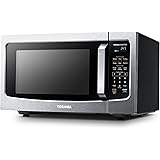
TOSHIBA ML-EM45PIT(SS) Countertop Microwave Oven with Inverter Technology, Kitchen Essentials, Smart Sensor, Auto Defrost, 1.6 Cu.ft, 13.6" Removable Turntable, 33lb.&1250W, Stainless Steel
$179.91 (as of January 14, 2026 19:13 GMT +00:00 - More infoProduct prices and availability are accurate as of the date/time indicated and are subject to change. Any price and availability information displayed on [relevant Amazon Site(s), as applicable] at the time of purchase will apply to the purchase of this product.)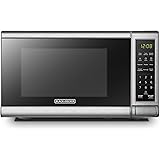
BLACK+DECKER EM720CB7 Digital Microwave Oven with Turntable Push-Button Door, Child Safety Lock, 700W, Stainless Steel, 0.7 Cu.ft
$79.99 (as of January 14, 2026 19:13 GMT +00:00 - More infoProduct prices and availability are accurate as of the date/time indicated and are subject to change. Any price and availability information displayed on [relevant Amazon Site(s), as applicable] at the time of purchase will apply to the purchase of this product.)